High school football in a small town had its own kind of mythology.
By junior year, I was living in it.
I started on both sides of the ball because, in small schools, that’s just what happened. Left tackle on offense. Right defensive end on defense. Special teams too, because apparently exhaustion was part of the curriculum.
And our coach?
His name was Mike Hunt.
Yeah… go ahead. Get the Porky’s joke out of your system now.
To us, though, he was just Coach.
Coach was built like pure compressed rage. Short, explosive, and capable of making even the biggest guys on the team instantly reconsider every life choice that had led them to screwing around at practice. He cared about us, no question. But preseason two-a-days were sacred ground, and there was zero tolerance for laziness.
The message was simple: show up ready on day one, or suffer.
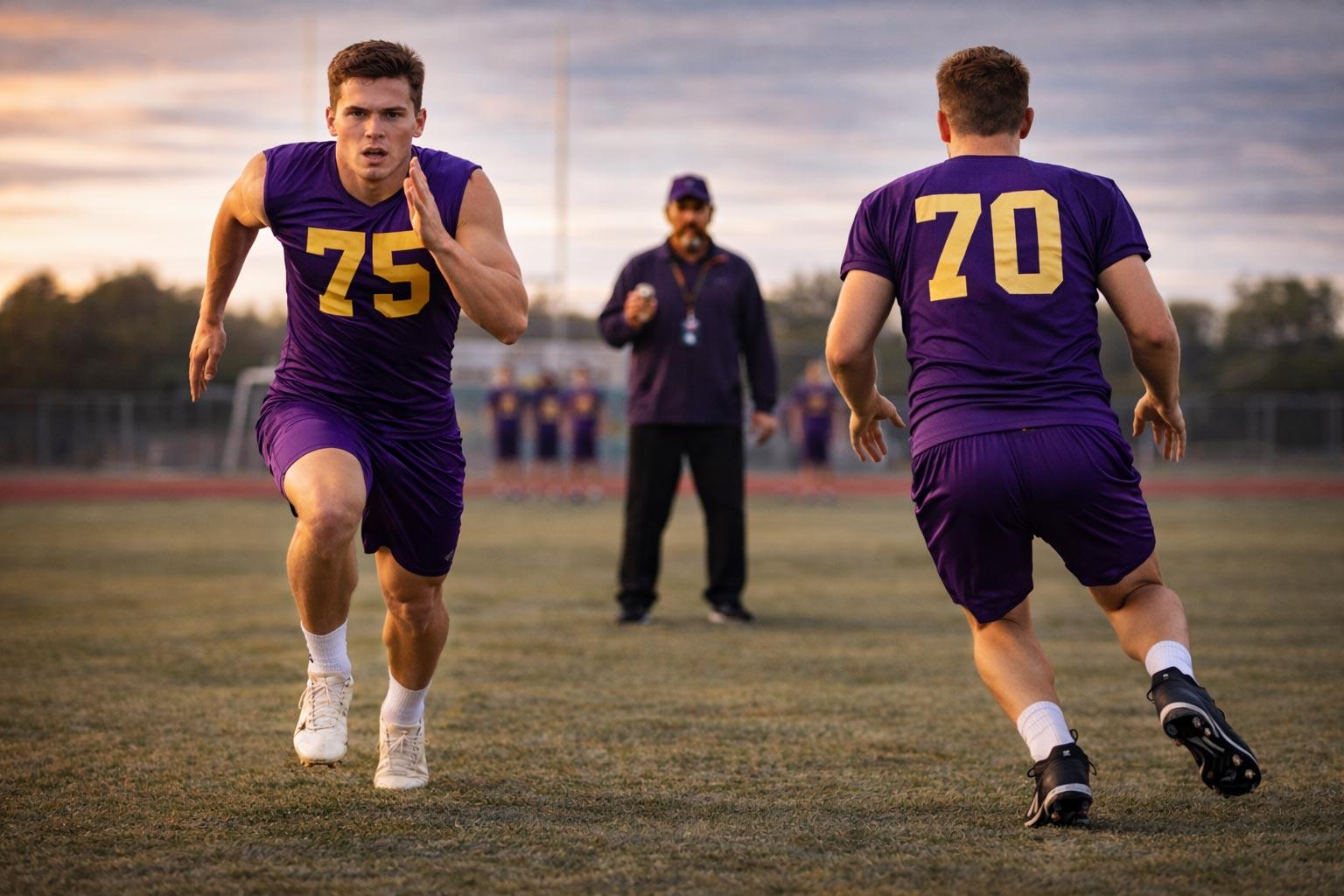
A few days into camp, we were running 40-yard sprints.
Everyone lined up on the goal line while Coach stood nearby with the whistle. At the 40-yard mark, Coach Wagner waited with the stopwatch.
Whistle blows.
Run.
Most of us were clocking under five seconds. Nothing elite, but solid enough for a bunch of farm kids who had spent summer lifting, hauling hay, and pretending that counted as conditioning.
Then there were the few guys who always seemed to miss the whistle, stumble out of the blocks, or jog like the whole thing was optional.
Those were the guys Coach couldn’t stand.
One afternoon, after another slow finish from Clem—the team’s unofficial president of NeverReallyCares—Coach finally snapped.
“Hardy! Get your ass over here. Now.”
That tone meant you moved before your brain caught up.
I jogged over to the goal line.
“Line up. You’re racing Clem.”
I remember thinking, What? Why me?
Clem was never anywhere near the top twenty in these sprints. I was usually one of the faster linemen. The whole thing felt unnecessary, but questioning Coach wasn’t part of the program.
So I got down on the line and waited.
Then Coach stopped everything.
“Stand up.”
I stood.
And that’s when he delivered the twist.
“You’re racing Clem… but you’re running backward.”
The whole team went dead silent for half a second.
Then the whistle blew.
Clem took off forward.
I started backward.
No, I didn’t run my usual 4.9.
But I still beat him.
By more than a second.
Running backward.
The team exploded.
Some laughed. Some shouted. Coach probably got exactly the lesson he wanted across.
At the time, all I felt was relief.
I had done what Coach told me to do, and in those days that felt tied directly to whether I’d be on the field Friday night under the lights.
But memory has a way of changing shape as you get older.
What felt like just another football story for years eventually turned into something else.
I realized later that Clem wasn’t really the lesson.
He was the target.
Coach had made an example out of him, and I became the tool that made the embarrassment unforgettable.
I wasn’t trying to humiliate my teammate.
I was trying to survive high school football.
Still, that doesn’t erase the sting of realizing you helped pile onto someone who was already struggling.
Funny how the stories we laugh hardest at when we’re young are sometimes the ones that make us wince the most later.
If this resonated with you, you’re not alone.