Somewhere between mortgages and medications… between schedules and responsibilities… the impossible starts feeling embarrassing.
But I never fully let go of airports.
Some kids grow up around baseball fields.
I grew up around runways.
The smell of avgas.
Sunlight pouring through dusty hangars.
The strange beauty of things that shouldn’t be able to fly… somehow lifting anyway.
Even after I stopped flying regularly, I still thought about airflow.
About pressure.
About lift.
About all the invisible things holding massive objects in the sky.
And one night, sitting alone with diagrams scattered across a workbench, I started wondering if airplanes had been fighting the wind all wrong this entire time.
The first sketches looked ridiculous.
Not wings.
Not rotors.
Not jets.
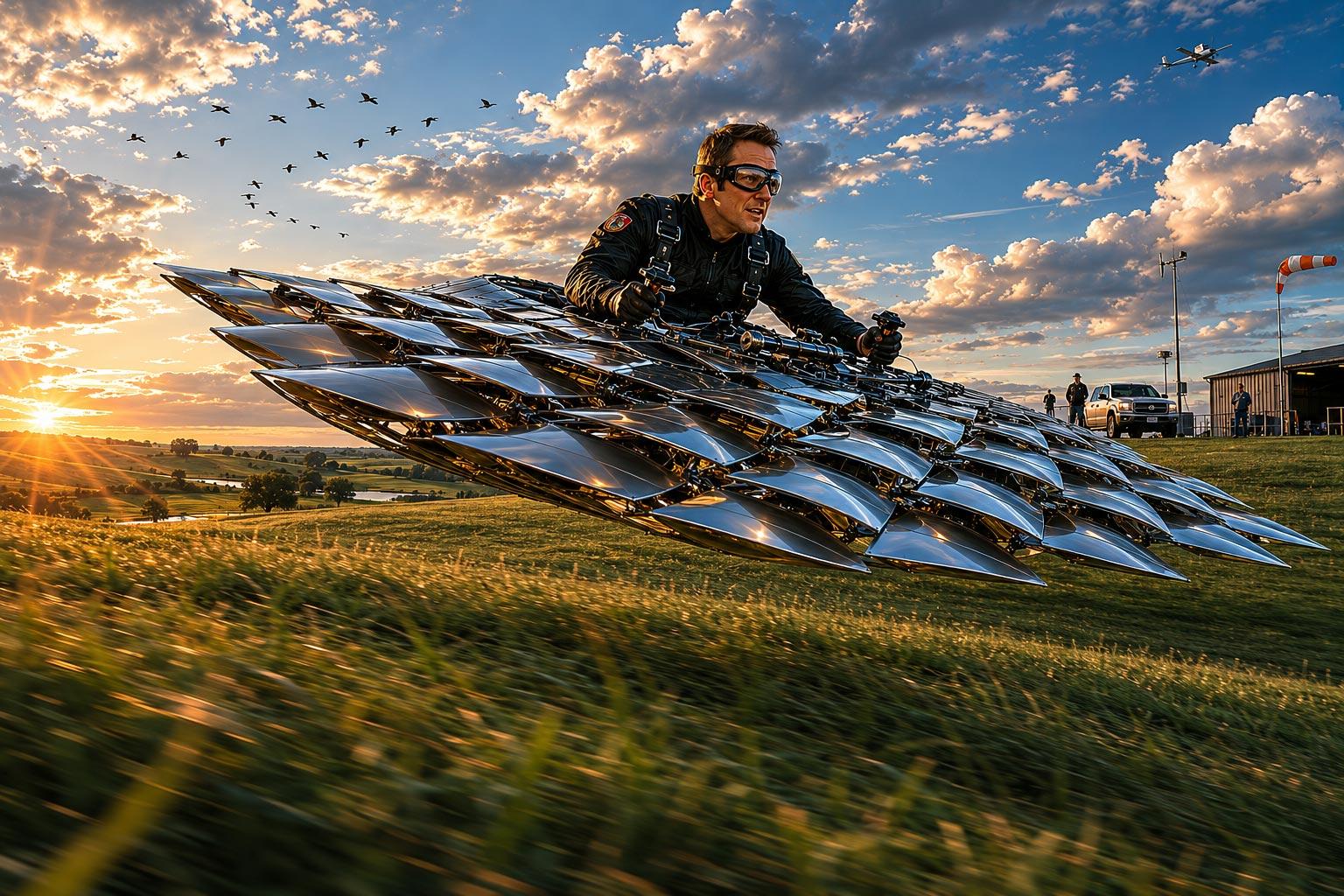
Just layers of curved metallic tiles arranged in shifting grids like Venetian blinds designed by a madman.
But the idea refused to leave me alone.
Each piece could move independently.
Each surface could catch airflow from a different direction.
Instead of resisting turbulence, the machine would absorb it… redirect it… amplify it.
The stronger the chaos around it became, the more stable the craft would grow.
At least that was the theory.
People smiled politely when I tried explaining it.
The same way adults smile at children holding cardboard rockets.
But I kept building.
Quietly.
Patiently.
Obsessively.
Most of the testing happened at sunrise when the wind was calm and the world still felt half-asleep.
The first prototype only carried one person.
An abandoned runway.
Cold morning air.
A machine humming softly beneath me.
Five running steps.
Then six inches off the ground.
Then two feet.
Then suddenly the machine wasn’t falling anymore.
It was listening.
That’s what I called it later when people asked how it worked.
“It listens to the wind.”
At first I thought nobody had seen the early flights.
I was wrong.
The videos spread slowly at first.
A strange silver craft floating silently above dry lakebeds and empty farmland with no visible fuel source. No propeller wash. No exhaust plume. Just motion… smooth and impossible.
Engineers became obsessed.
Oil companies became nervous.
The internet became unbearable.
But somewhere inside classrooms and garages and aging workshops all over the world, something unexpected started happening.
People started sketching again.
Older men dug half-finished inventions out of storage boxes.
College students changed majors.
Kids started drawing impossible machines in notebook margins instead of giving up before they even began.
Because the machine didn’t just prove flight could change.
It proved imagination didn’t have an expiration date.
And maybe that’s why people connected to it so deeply.
Not because they believed they’d ever fly one themselves…
…but because somewhere along the way, they missed the version of themselves that still believed impossible things were worth chasing.
If this resonated with you, you’re not alone.