I had the privilege—or depending on the day, the cardiovascular stress test—of teaching all three of my daughters how to drive.
I grew up on a farm.
Farm kids learn machinery the same way fish learn water. You don’t wake up one morning and suddenly drive a vehicle. You sort of evolve into it.
First came tricycles.
Then bicycles.
Then riding mowers.
Then tractors.
Then larger tractors.
Then machinery that probably shouldn’t have been entrusted to a teenager.
By the time I was old enough to drive on public roads, controlling a machine that weighed a few thousand pounds felt fairly natural.
The girls didn’t have that progression.
They grew up in the city.
Their path looked more like Barbie Jeep.
Bicycle.
Nintendo Mario Kart.
Actual automobile.
That’s a pretty aggressive jump in difficulty.
One minute you’re throwing banana peels at your friends.
The next you’re merging onto Interstate 80.
Needless to say, there was a learning curve.
One of the first things young drivers struggle to understand is that a vehicle isn’t just transportation.
It’s physics.
Mass.
Momentum.
Traction.
Stopping distance.
Weather.
Consequences.
A car doesn’t care how old you are or how good your intentions might be.
A car only obeys physics.
And physics can be remarkably unforgiving.
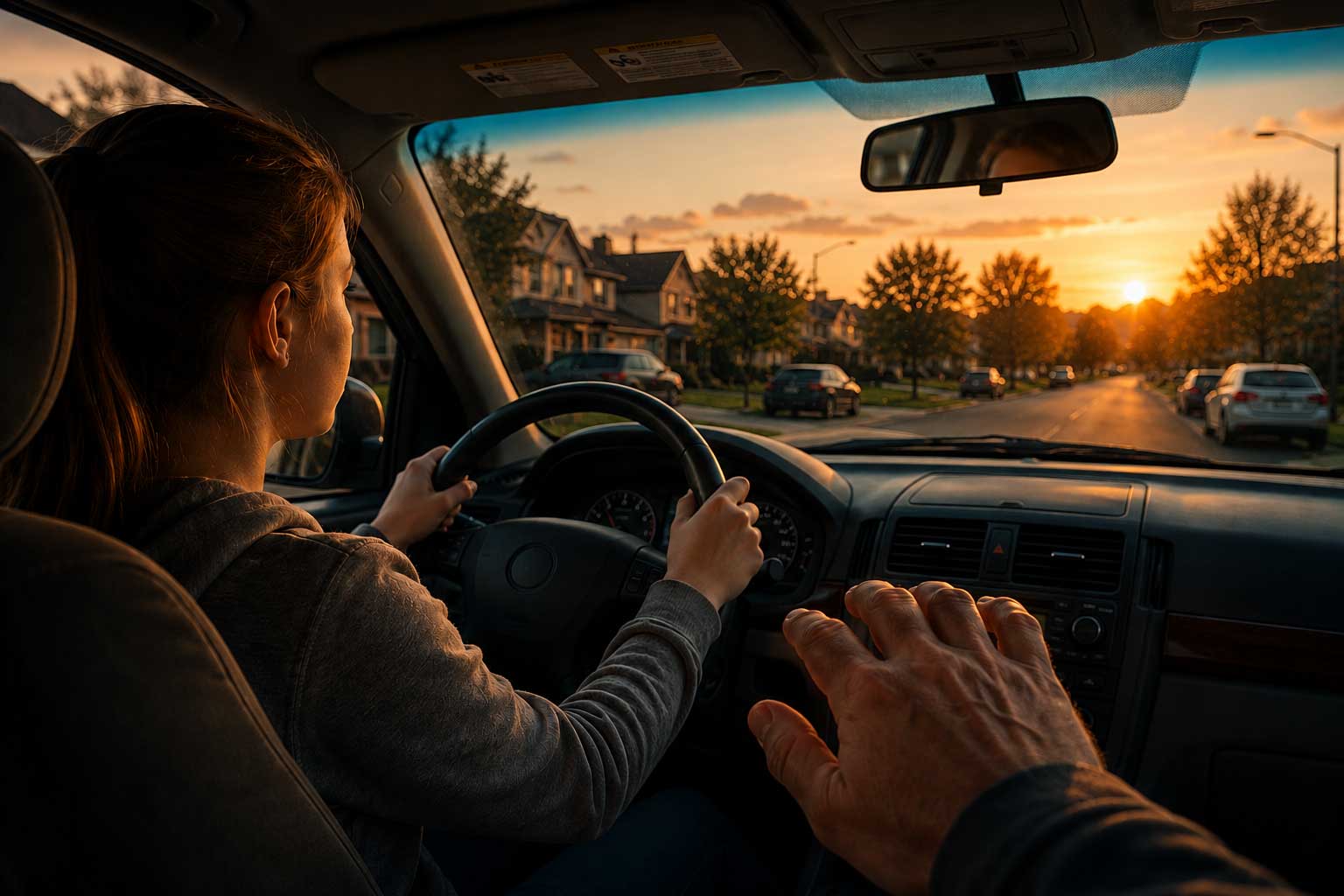
There were a few occasions where I found myself reaching across the console to help steer us away from a light pole that seemed to be growing larger at an alarming rate.
There were a couple of moments when I introduced my daughters to a lesser-known feature of the family vehicle.
Dad’s emergency brake.
One incident stands out more than the others.
We were approaching a red light.
A police officer sat nearby in his patrol car, watching traffic.
The light changed.
We were still moving.
Quite enthusiastically.
I waited.
Surely my daughter saw it.
Surely she was slowing down.
Surely—
Nope.
At roughly fifty yards from the intersection, I realized we were moments away from becoming a very educational traffic stop.
I grabbed the emergency brake.
Hard.
The tires protested.
The pavement protested.
The smell of rubber briefly filled the air.
I’m fairly certain we left behind enough tread to manufacture a new set of flip-flops.
When we finally stopped, I looked over at the police officer.
He looked over at me.
For a second neither of us moved.
Then he smiled.
Not the smile of a cop who had just witnessed a traffic violation.
The smile of a man who knew exactly what had happened.
The smile said:
“Teaching a teenager to drive?”
I nodded.
He nodded.
The light turned green.
We both carried on with our day.
It felt a little like professional courtesy.
Over time, things improved.
We practiced neighborhood streets.
Then city traffic.
Then highways.
Then interstate traffic.
Merging.
Turn signals.
Mirror adjustments.
Following distance.
Blind spots.
Parallel parking.
I taught them one lesson that I still use every day.
Whenever possible, make eye contact with other drivers.
Not because it’s polite.
Because it tells you whether they’ve actually seen you.
A turn signal is helpful.
A glance is better.
Eye contact is confirmation.
It’s amazing how many accidents can be avoided simply by knowing whether another person is paying attention.
Slowly, mile after mile, the panic began to fade.
The death grip on the passenger-side armrest relaxed.
My foot stopped searching for an imaginary brake pedal.
The emergency brake enjoyed a well-deserved retirement.
Eventually they all passed their driving tests on the first try.
And that was the strange part.
For years I thought the goal was teaching them how to drive.
It wasn’t.
The goal was teaching them how to leave.
Not leave home.
Leave dependence.
Driving is one of those invisible milestones that sneaks up on parents.
One day you’re buckling a child into a car seat.
The next you’re standing in the driveway watching them back out on their own.
The seat beside you sits empty.
And somehow that’s exactly what you worked for.
Today, when I ride with my daughters, I feel pretty confident that I won’t die.
That’s a comforting development.
But every once in a while, I still catch myself reaching toward the dashboard for a brake pedal that isn’t there.
Old habits die hard.
Parenting habits die even harder.
Because being a parent is a little like teaching someone to drive.
At first you’re controlling everything.
Then you’re sharing control.
Then you’re mostly offering advice.
And eventually you’re just sitting in the passenger seat hoping they remember what you taught them.
So far, they have.
And that’s all any parent can really ask for.
If this resonated with you, you’re not alone.