Laura was always up before me.
On Tuesday morning, September 11, 2001, she was getting ready for work in front of the bathroom mirror, doing her hair and makeup while WOWT Channel 6 played in the background—just like every morning, and just as it still does today.
It was an ordinary weekday morning in Omaha.
We had jobs to get to. There was weather to check. There was nothing yet to suggest that this particular Tuesday would become a date people would remember simply by saying two numbers.
9/11.
At 7:46 a.m. Central time, American Airlines Flight 11 struck the North Tower of the World Trade Center in New York City.
I didn’t know any of that yet.
What I remember hearing on Channel 6 was much simpler.
A plane had hit one of the skyscrapers in New York.
Plane.
That word mattered.
If the reporter had said a commercial airliner had flown into the World Trade Center, I don’t know that I would have done what I did next. But when I heard plane, my mind immediately constructed an explanation that made sense to me.
Some idiot pilot had screwed up.
I knew small airplanes and helicopters flew sightseeing routes around big cities. I was a pilot myself, and my mom had taught me to fly. I also understood what tall buildings could do to wind.
Years earlier, when Laura and I lived in Omaha’s Old Market, I walked to work from the Bolt, Nut and Screw lofts near 13th and Jones to the Omaha Building at 16th and Farnam. Walking uphill on Farnam during winter could be brutal. The buildings funneled the wind through downtown until it felt like it was trying to knock you backward. On especially cold mornings, I’d stop halfway at a drugstore for coffee just to warm up before continuing.
So a pilot getting caught by unexpected winds around Manhattan?
That made sense to me.
I called Mom.
“Turn on Channel 6. Some idiot crashed his sightseeing plane into one of the towers.”
I can’t swear those were my exact words twenty-five years later. But that was certainly what I thought had happened, and it was why I called her.
She had taught me to fly.
This was something the two of us could talk about.
Then the television showed us the building.
This wasn’t what I had pictured.
There was an enormous black wound in the side of the North Tower, with fire and smoke pouring from it. Whatever had hit that building had done far more damage than the little airplane I’d imagined.
I still tried to make the explanation fit.
Maybe the airplane had gone through part of the building. Maybe pieces had fallen to the street. Maybe there was something about the impact we couldn’t see.
Mom stayed on the phone. Laura was watching too.
At 8:03 a.m. Central time, seventeen minutes after the first impact, another airplane appeared on live television.
This one we saw.
United Airlines Flight 175 was a Boeing 767.
It crossed the television screen and flew directly into the South Tower.
For one impossible instant, the airplane seemed to remain completely intact. I expected a wing to shear off. An engine to separate. Something to bounce away.
Nothing did.
The building seemed to swallow the airplane whole.
Then came the fire.
There are moments when your brain understands something before you’re ready to say it aloud.
Three people were watching that television that morning—Laura and me in our home in Omaha, Mom on the other end of the telephone.
None of us needed a reporter to explain what had just happened.
The first plane might have been an accident.
The second plane changed everything.
We still had to go to work
That seems ridiculous now.
Two airliners had just flown into the World Trade Center. The towers were burning on live television. Nobody knew what else was happening.
And Laura and I realized we were going to be late for work.
So I hung up the phone and got ready to leave.
But I couldn’t imagine simply turning off the television and going about my day.
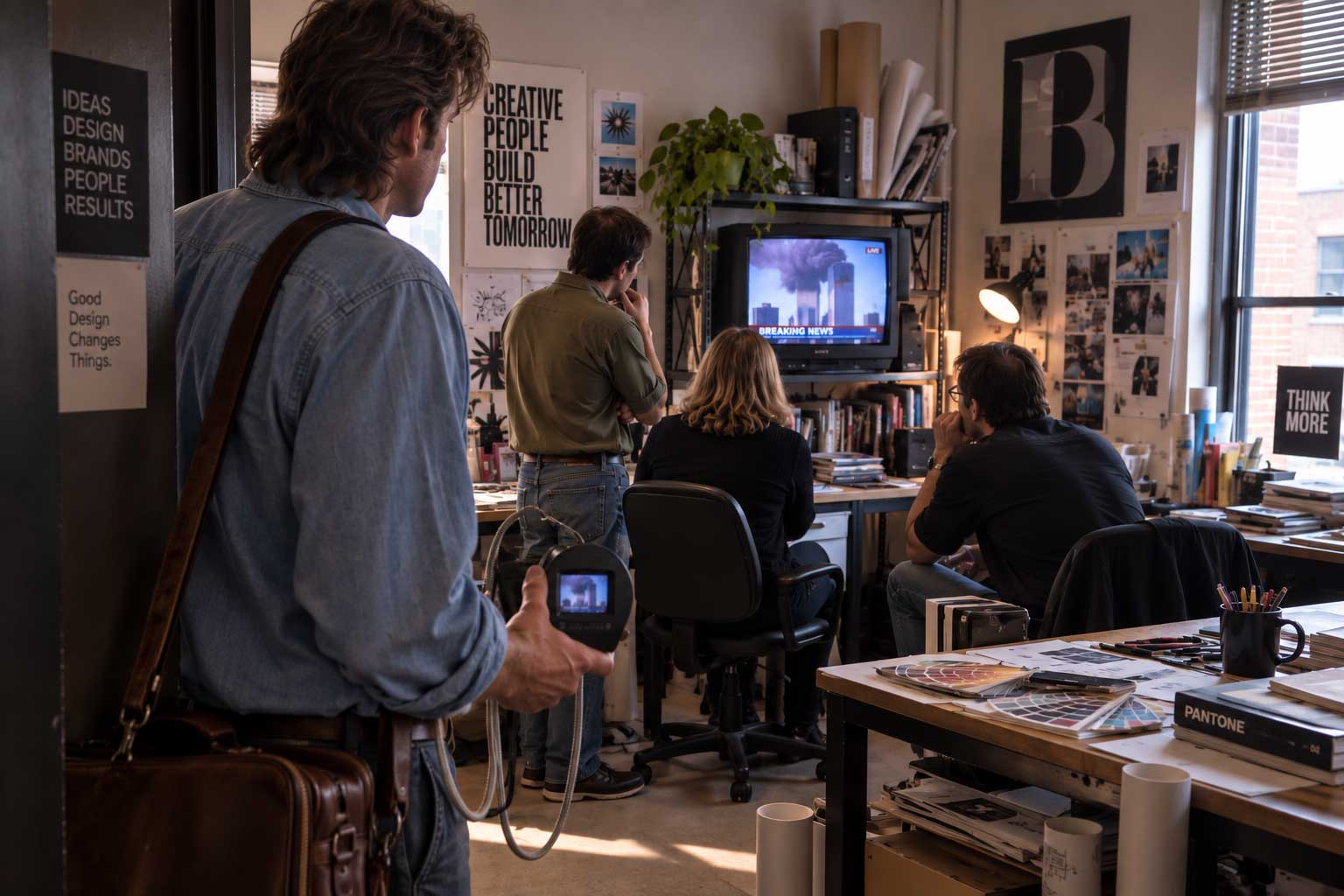
I had a little portable color TV, so I took it with me.
And when I say little, I mean little.
The screen couldn’t have been much more than three inches across. The antenna wasn’t a metal rod sticking out of the top. It was built into the cable that went around my neck, so I could literally carry a color television with me.
In 2001, that seemed pretty advanced.
Looking at one twenty-five years later, I have no idea how we watched anything on it.
But that morning I carried it to work because I didn’t want to miss what happened next.
On the drive, I listened to the radio.
Reports were coming quickly and sometimes contradicting one another. Other aircraft couldn’t immediately be accounted for. Flights were being stopped. Eventually, aircraft already in the sky would be ordered to land.
By then there was no question in my mind that America was under attack.
I just didn’t know how large the attack was.
When I walked into the office carrying my little television, I discovered someone else had already beaten me to it.
There was a television on.
Everyone was gathered around it.
Nobody was really working.
We were designers and creative people. Normally there would have been conversations, phones ringing, projects scattered around, people moving from one thing to another.
That morning the work just sat there.
We watched.
Another hijacked airliner crashed into the Pentagon.
Then the South Tower collapsed.
I remember watching a building that enormous simply disappear into a rolling cloud of dust and trying to understand how that was physically possible.
News came that another hijacked airplane, United Airlines Flight 93, had crashed in a field near Shanksville, Pennsylvania.
We would later learn that passengers aboard that flight had discovered what was happening elsewhere. They understood that their airplane was likely going to be used as another weapon.
So they fought back.
They didn’t survive.
But the hijackers never reached their intended target.
Then the North Tower came down.
The World Trade Center towers were gone.
A little more than an hour and a half earlier, they had simply been part of the New York skyline.
Now thousands of people were dead or dying.
And the rest of us were trying to understand what we had just witnessed.
The people inside
There are images from that day I wish I hadn’t seen.
People were trapped above the fires.
Some appeared at windows desperately looking for air or rescue.
Others jumped.
Even twenty-five years later, that is difficult for me to think about.
I don’t think of those people as choosing to die.
I think they were human beings trapped between two impossible ways of dying.
Watching them fall made the enormity of what was happening impossible to hide behind words like attack, terrorism or World Trade Center.
Those weren’t buildings burning.
There were people inside them.
Someone’s husband.
Someone’s wife.
Someone’s son or daughter.
Someone’s mom.
Someone who had gotten up that morning, taken a shower, poured some coffee, gone to work and probably thought about what they were going to do when they got home.
Just like Laura and me.
Just like the people sitting around that television in our office.
Just like millions of people who had started September 11 as an ordinary Tuesday.
And then people ran toward it
There was evil on television that morning.
There is no softer word I know for deliberately killing innocent people.
But there was something else on television too.
Firefighters ran toward the towers.
Police officers ran toward them.
Paramedics and rescue workers ran toward them.
Ordinary people helped strangers they had never met.
While thousands of people were desperately trying to get out, firefighters carrying heavy equipment were climbing the stairs to go in.
Many knew how dangerous it was.
They went anyway.
On Flight 93, ordinary passengers understood enough about what was happening to know they probably weren’t going home.
They could not control what had already happened.
They could control what they did next.
They fought back.
Over the days and weeks that followed, thousands more people came to help. Rescue workers searched the wreckage. Volunteers brought food and water. People donated blood. People stood in lines waiting for some small way to be useful.
For a while, it seemed like the worst thing human beings could do had reminded the rest of us of the best things human beings could do.
Later that day, even Omaha became part of the unfolding story.
President George W. Bush arrived at Offutt Air Force Base and communicated with national-security officials from U.S. Strategic Command.
The thing we had watched happening more than a thousand miles away had somehow reached Nebraska too.
Twenty-five years later
Here we are.
September 11, 2026.
Twenty-five years have passed.
Children born after the attacks are adults now. There are people raising families who have no memory of the World Trade Center towers standing in New York because they weren’t alive when they fell.
And the world still hasn’t figured itself out.
There are still wars.
There is still hatred.
We still divide ourselves by countries, religions, politics, race, lifestyles and beliefs.
We still decide someone else is wrong.
Sometimes we decide they’re evil.
And somewhere on the other side, there’s probably somebody who has decided the same thing about us.
Most of us don’t have much power over any of it.
I can’t stop a war.
I can’t settle an argument between nations.
I can’t make billions of people agree about religion, politics or how everyone else should live.
Neither can you.
But September 11 taught me something about the part we can control.
When someone needs help, we can walk away.
Or we can walk toward them.
If you’re reading this in 2076
I don’t know what your world looks like.
I don’t know what countries are fighting.
I don’t know what people are angry about.
I don’t know what technology you’re using to read this, or whether the little three-inch television I carried around my neck sounds as ancient to you as a telegraph sounds to me.
And unless some fairly impressive medical advances happen between now and then, I won’t be around for you to tell me.
But I hope one thing hasn’t changed.
On September 11, 2001, human beings did something terrible to other human beings.
And then thousands of other human beings ran toward the people who needed them.
That’s the part I want you to remember.
You may never have control over governments, wars, religions or the arguments that convince people they should hate someone they’ve never met.
But you will have control over what happens when someone standing in front of you needs help.
You can walk past them.
Or you can walk toward them.
Twenty-five years after I watched those towers burn from a bedroom in Omaha, Nebraska, I still believe most good people will walk toward them.
If you’re reading this fifty years from now, I hope I’m still right.
If this resonated with you, you’re not alone.