I grew up in airplanes.
My dad earned his pilot’s license when he was around twenty. Then came his instrument rating, commercial license, and aerobatics training in Casa Grande, Arizona, before he became a crop duster.
By the time I took my first airplane ride, I was probably still in diapers.
So there was nothing particularly unusual about Dad and me being somewhere over Kansas in a Cessna 210.
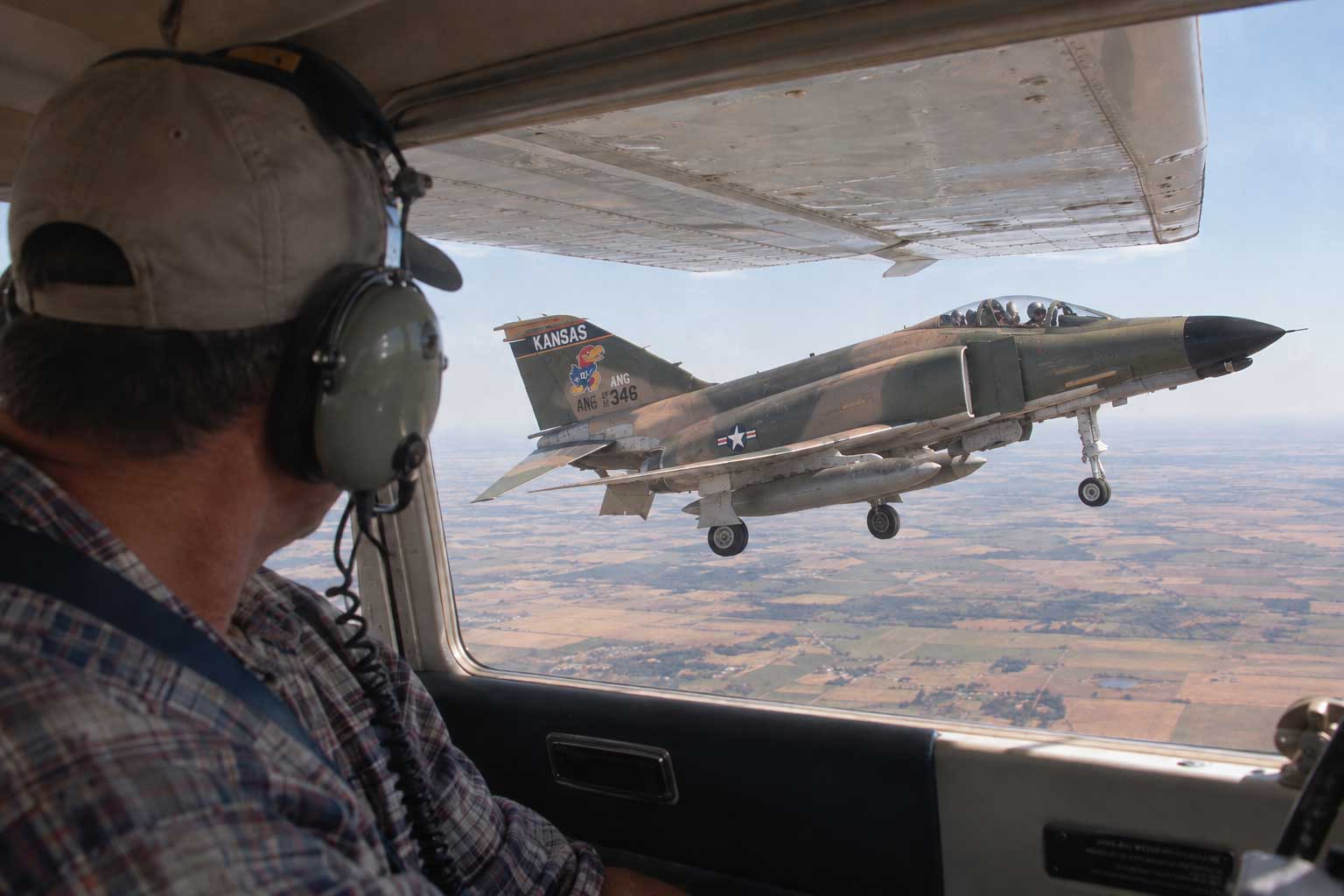
The F-4 Phantom that pulled up beside us was a little more unusual.
This would have been sometime in the mid-1980s. We had flown down to Wichita to Cessna Aviation to pick up parts for the mechanic who was doing the annual inspection on our other airplane, a Cessna 172.
Now we were headed home to Tekamah, Nebraska.
Dad knew there was military airspace nearby.
He just didn’t think we were quite that nearby.
I don’t remember seeing the fighter approach.
I remember it being there.
One moment it was Dad and me in a Cessna, flying across Kansas.
The next, there was a military fighter outside the window.
And it looked completely wrong.
Its landing gear was down. Its flaps were extended. The nose was pitched upward at an angle that made it look less like it was flying beside us than trying desperately not to fall out of the sky.
We were moving at Cessna speed.
It most definitely was not built for Cessna speed.
There’s actually an aerodynamic explanation for what I remember seeing. At very low speeds, an F-4 had to fly at a high angle of attack to generate enough lift. Dirtying it up with the landing gear and flaps added drag and helped the pilot control the speed. The result was sometimes described as “mushing” through the air.
In other words, yes, a Phantom could fly that slowly.
It just looked like it had no business doing it.
I remember looking across at the pilot.
He wanted our attention.
Then he started holding up fingers.
One.
Two.
One.
Five.
121.5.
The emergency frequency.
Dad got on the radio.
Whatever happened next resulted in one unmistakable instruction: we needed to get the hell out of wherever we were.
The fighter banked away.
Dad followed.
For a while, one of the fastest military aircraft in the world led a little Cessna across the Kansas sky.
Then, apparently satisfied that we were no longer where we weren’t supposed to be, the fighter left.
And I mean left.
Now it was quiet again.
Just Dad, me and the Cessna.
There was only one small problem.
Dad wasn’t entirely sure where we were.
Remember, this was the 1980s.
There was no moving map glowing on an instrument panel. No GPS dot showing exactly where the airplane was. Navigation meant charts, headings, radios, landmarks and knowing how to look out the damn window.
Dad looked down at Kansas.
Then he started descending.
There was a town ahead of us.
And every good Midwestern town came with its own enormous aviation navigational aid.
A water tower.
Dad kept descending until we were low enough to read the name painted across it.
I believe it may have been Clay Center, although forty years later I can’t swear to that.
It didn’t matter.
Now we knew where we were.
Dad had me pull out the aviation sectional and our handheld flight computer—the flying equivalent of an abacus.
He showed me how to use it.
With the town beneath us as our known position, we replotted the course, figured the heading we needed, and pointed the Cessna toward Tekamah.
That was Dad.
A fighter jet could pull alongside him and tell him he’d screwed up, lead him halfway across Kansas, and a few minutes later he’d be reading a water tower, handing me a sectional and teaching me how to find our way home.
Not long after that flight, I earned my own pilot’s license.
By then, Dad had already been teaching me to fly for most of my life.
I’ve spent the rest of my life knowing how to find my way home.
Because he taught me how.
If this resonated with you, you’re not alone.