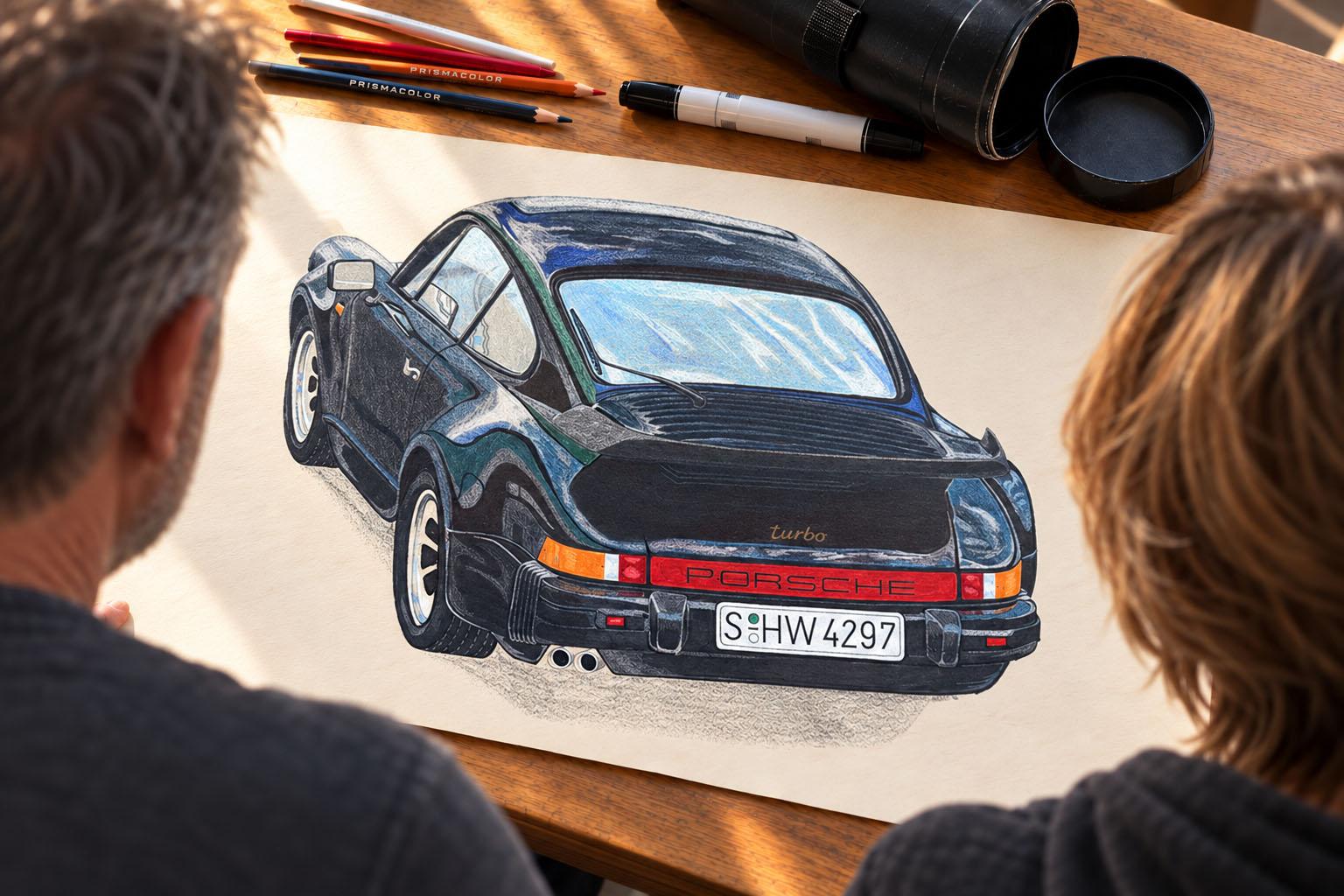
In 1990, I drew a Porsche 930 Turbo.
Not on a computer.
There really weren’t computers for this kind of thing yet.
I was taking a class from Al Kraning, who taught us how cars were designed before everything became digital. We learned about the clay models engineers and designers used in automotive production and how to render something three-dimensional on a flat piece of paper.
My Porsche was done with markers and Prismacolor pencils.
That was pretty much it.
I chose the car myself.
It was beautiful. It was fast. It was expensive.
And I fully expected to own one.
I was 24 years old, finishing college and preparing for a career in marketing and advertising. I’d been told what a lot of us were told back then: get your degree, work hard and you’ll make good money.
I knew I was going to become an executive at a marketing or advertising company.
Executives made six figures.
In my 24-year-old brain, six figures meant something like $200,000 a year.
Apparently I had forgotten that six figures could include decimal points.
My first job paid a little over $20,000.
Suddenly the Porsche was a little farther away.
So was living by myself.
I split rent and utilities with a roommate in a cool retrofitted apartment and began learning something they probably should have offered as a required course in college.
Real-world economics.
I didn’t give up on the Porsche, though.
I’ve always been an optimist.
I still flew airplanes, although the airplanes belonged to my parents and I had to borrow the keys. I believed my career would advance, and eventually it did. I met Laura. We got married. We had Peyton, then Madie and Sloan. I built a career and eventually started my own company.
Along the way, I did manage to buy some pretty great cars.
When I met Laura, I was driving a white 1990 Honda Prelude. Cool car.
Not a Porsche.
In 2001, while working at an ad agency, I ordered a brand-new BMW 330 with the M package. Titanium silver. I ordered it from Germany because I wanted a manual transmission and the cars at the dealership were automatics.
I wanted to go fast.
Years later, Ricky Bobby would finally give me the appropriate words for that.
I have pictures of Peyton and me hand-washing that BMW when she was little.
I loved that car.
But I never had a moment when I stood beside it and thought:
I’ve made it.
I’m 60 now.
I’m still working on that.
The Porsche drawing, meanwhile, disappeared.
A couple summers ago, I was at a pool party at a lodge brother’s house. One of his kids attends Kansas State University and is an artist. In the bar was an illustration his kid had done of another very cool car.
It immediately reminded me of my Porsche.
I hadn’t thought about that drawing in years.
Over the next couple of days, I started looking for it.
I went through portfolios. Tubes. Closets. Old artwork.
Nothing.
Eventually I decided I must have thrown it away somewhere along the line.
That bothered me more than I expected.
Then last week, Madie needed a waterproof tube to transport some of her artwork.
She’s studying art at the University of Nebraska Omaha.
I told her I had one.
I knew the tube wasn’t empty. Over the years I’d put artwork and old graphic design posters in it, so I opened it up and started taking things out.
And there it was.
The Porsche.
Thirty-six years later.
Good as new.
I could have sworn I’d looked in that tube.
There’s an episode of the 1985 version of The Twilight Zone called “A Matter of Minutes.” In it, a couple discovers that every minute of reality is actually assembled just before we arrive in it. Crews put everything where it’s supposed to be.
The explanation for those times when you lose your keys, look exactly where you know you left them, then come back later and they’re suddenly sitting there?
Somebody on the crew forgot to put them there the first time.
That’s the only reasonable explanation I have for the Porsche.
Somebody forgot to put it in the tube when I looked two years ago.
Madie saw it when I did.
“Wow.”
Her art is different from mine. She does some amazing anime work. The Porsche is almost technical or engineering art by comparison.
I never taught her how to draw.
She just could.
I’ve watched her work and been impressed by what she can do. We share a lot of the same interests in computers and technology, and lately she’s become more interested in some of the older artwork I’ve pulled out.
But standing there looking at that Porsche with her felt different.
It was like finding a missing link.
With all the technology we have now, I was amazed by what I had done.
No undo button.
No layers.
No generative fill.
Markers. Colored pencils. Paper.
And my hands.
I almost cried.
Graphic design and computers eventually replaced most of my drawing and illustration. I always figured I’d come back to traditional art someday or find another way to express that part of myself.
I think I did.
I just didn’t recognize it immediately.
Somewhere in the middle of running my own company, I stumbled into Why Are You Sad? (WAYS?).
Instead of drawing pictures, I started drawing memories with words.
The tools changed.
The imagination didn’t.
Maybe when I retire I’ll pick up pencils, markers or paint again. I’d like to make things without technology involved. There’s something pure about putting your hand against a piece of paper and creating something that didn’t exist before.
But there’s something else I see when I look at that Porsche now.
The guy who drew it didn’t know shit.
I don’t mean that badly.
I like that guy.
He and I made a lot of bad decisions together.
We’ve also had one hell of an adventure.
At 24, I thought I had a pretty good idea what success looked like.
A great career.
A lot of money.
A Porsche 930 Turbo.
Today, if somebody handed me enough money that buying that exact Porsche meant absolutely nothing financially, I don’t think I’d buy it.
I’d rather have an airplane.
I’d rather have a lake home where my family could gather.
I’d rather take all of us on some ridiculous European vacation.
Mostly, I want to spend time with my family and watch my kids succeed.
Apparently 24-year-old me was a little materialistic.
Sixty-year-old me has gotten sappy.
But I don’t think the younger version was wrong.
He was just playing an earlier level.
That’s increasingly how I think about life.
You get things wrong.
You learn.
You correct on the fly.
You get something else wrong.
You do it again.
I’ve never really felt like I’ve “made it,” and maybe that’s because I don’t think there is a point where you’re supposed to be finished.
There are too many things I still don’t understand.
I’ve spent enough time around Masonry, faith and ideas bigger than myself to wonder whether there’s another level after this one. Another dimension. Another form. More knowledge. More life. More freedom.
I don’t know.
None of us do.
Maybe we’re here until we figure out whatever we’re supposed to figure out.
Maybe if we don’t, we get sent back to try the level again.
Or maybe that’s not how any of this works.
Either way, I’m trying to get to BOSS LEVEL.
For now, the Porsche isn’t framed.
I don’t really have anywhere to put it.
Madie has the tube while she finishes the semester. When she’s done, her artwork will come out and the Porsche will probably go back in.
I’ll take a good photograph of it first.
Someday, maybe one of my kids will want it.
Maybe they won’t.
Maybe years from now somebody else will open that tube and wonder why in the hell someone kept an old drawing of a Porsche.
That’s okay.
It doesn’t represent the car I never got.
It represents a 24-year-old kid sitting in Al Kraning’s class in 1990, drawing what he thought his future looked like.
He was spectacularly wrong.
And somehow, I’m glad he was.
If this story resonated with you, you’re not alone.